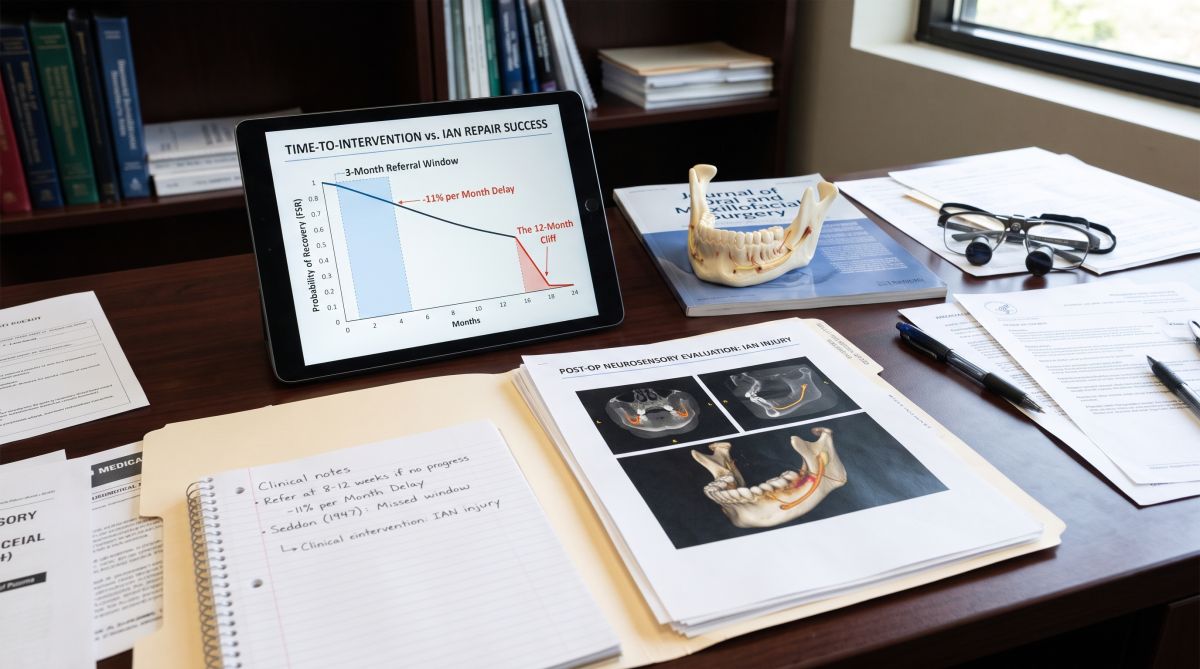
In oral and maxillofacial surgery, the instinct to adopt an expectant posture toward post-operative sensory disturbance is understandable. We know that the peripheral nervous system possesses innate regenerative capacity. Neuropraxic injuries resolve spontaneously, post-operative edema dissipates, and mild paresthesias frequently clear within weeks.
However, when an expectant attitude transforms into unmonitored, open-ended observation, it ceases to be conservative management. It becomes clinical neglect.
More than sixty years ago, Sir Herbert Seddon established a surgical truism that should govern every peripheral nerve injury:
"If a purely expectant policy is pursued, the most favorable time for operative intervention will be always missed." — Sir Herbert Seddon, 1947
In our comprehensive retrospective cohort study of 186 inferior alveolar nerve (IAN) microsurgical repairs published in the Journal of Oral and Maxillofacial Surgery, we evaluated the precise mathematical and biological costs of surgical delay.
The empirical evidence is unequivocal: the passage of time directly diminishes the surgeon's ability to restore functional sensation.
The Mathematics of Delay: An 11% Penalty Per Month
In our study population, the mean time elapsed from the initial nerve injury to microsurgical intervention was 10.7 months (ranging from 0 to 72 months). This delay was largely driven by postponed referrals from the initial treating clinicians.
Multivariate logistic regression analysis of our cohort demonstrated a significant negative association between the duration of injury and the attainment of Functional Sensory Recovery (odds ratio, 0.898).
+-------------------------------------------------------------------------+
| TIME-TO-INTERVENTION VS. REPAIR SUCCESS
|
| Probability of Functional Sensory Recovery (FSR)
| 100% | * * *
| 80% | * * * * *
| 60% | * * * *
| 40% | * * * * *
| 20% | * * * [ THE 12-MONTH CLIFF ]
| 0% +------------------------------------------------------------
| Month 0 Month 3 Month 6 Month 9 Month 12+
| |
| * Linear Decline: -11% odds of functional recovery per month of delay.
+-------------------------------------------------------------------------+
Receiver operating characteristic (ROC) curve analysis pinpointed a definitive prognostic threshold: a dramatic drop in the rate of successful sensory restoration occurs at 12 months post-injury.
While repairs performed beyond one year can occasionally achieve protective sensation, operating after this threshold forces the surgeon to work against severe biological headwinds. Distal Schwann cell basal laminae collapse, endoneurial tubes undergo irreversible fibrosis, and central retrograde chromatolysis reduces the parent sensory ganglion's capacity to drive axonal elongation.
Clinical Factors That Do NOT Dictate Success
Surgeons often delay referral because they believe specific clinical mechanisms or presentation profiles are inherently untreatable. Our multivariate analysis systematically disproved these assumptions:
|
Clinical Variable |
Impact on Functional Sensory Recovery (FSR) |
Statistical Significance |
|
Etiology of Injury |
Third molar, SSRO, trauma, and implants showed equivalent repair success. |
P = NS |
|
Operative Injury Type |
Compression, neuroma, partial cut, or total transection responded similarly. |
P = NS |
|
Specific Surgical Procedure |
Decompression, neurolysis, neurorrhaphy, and grafting achieved high FSR. |
P = |
|
Presence of Pre-Op Pain |
Concomitant pain did not decrease the ultimate rate of sensory restoration. |
P = NS |
|
Duration to Repair |
Direct linear decline; marked failure increase past 12 months. |
P < .001 |
|
Patient Age |
Decreasing recovery rate past 51 years of age (~3% loss per year). |
P < .015 |
Neither the cause of the injury nor the presence of neuropathic pain dictates the outcome of microneurosurgical repair. The primary predictive variable within clinical control is timing.
+-------------------------------------------------------------------------+
| THE BAGHERI THREE-MONTH REFERRAL RULE
|
| [ Day 0 to Week 2 ] -> Immediate post-op neurosensory deficit noted.
| [ Week 4 to Week 6 ] -> Serial neurosensory testing; if sensation is absent or worsening, do not dismiss.
|
| [ Week 8 to Week 12 ] -> Absence of objective neurosensory progress mandates immediate microsurgical referral.
|
| [ Past Month 3 ] -> Patient must be evaluated by a microsurgeon to plan elective exploration before fibrosis sets in.
|
+-------------------------------------------------------------------------+
Actionable Triage for the Referring Clinician
How should the surgical practitioner manage a nerve deficit following third molar extraction, sagittal split osteotomy, or implant placement?
- Abandon the Subjective Query: Simply asking a patient "Does this feel like it's getting better?" yields unreliable data. Patients adapt cognitively to sensory deficits, confusing sensory accommodation with biological nerve regeneration.
- Execute Serial Objective Testing: Utilize standardized, reproducible clinical neurosensory testing (Level A two-point discrimination, Level B Semmes-Weinstein light touch, and Level C pinprick).
- Recognize Observed vs. Unobserved Injuries: If an inferior alveolar canal is observed on post-operative CBCT to be breached by an implant fixture or an internal fixation screw, or if a nerve was directly visualized as transected during osteotomy, immediate referral is required. There is zero clinical justification for observation when structural impingement or discontinuity is radiographically evident.
- Refer Early for Mapping: Recommending a specialist consultation at six to eight weeks does not commit the patient to surgery. It establishes an authoritative, objective neurosensory baseline. If serial testing demonstrates measurable progress, conservative management continues safely. If sensation remains absent at three months, definitive surgical intervention can occur within the optimal biological window.
Fulfilling Our Professional Mandate
In maxillofacial reconstructive surgery, our shared imperative is clear: Do No Harm. When dealing with peripheral trigeminal trauma, doing no harm means refusing to let the clock run out on a patient's regenerative potential.
Adopting an expectant policy without structured, time-delimited endpoints actively harms our patients. By retiring the passive "wait-and-see" mindset and embracing proactive, objective assessment within the first 90 days, we give every patient the highest statistical probability of regaining their sensory function and facial quality of life.