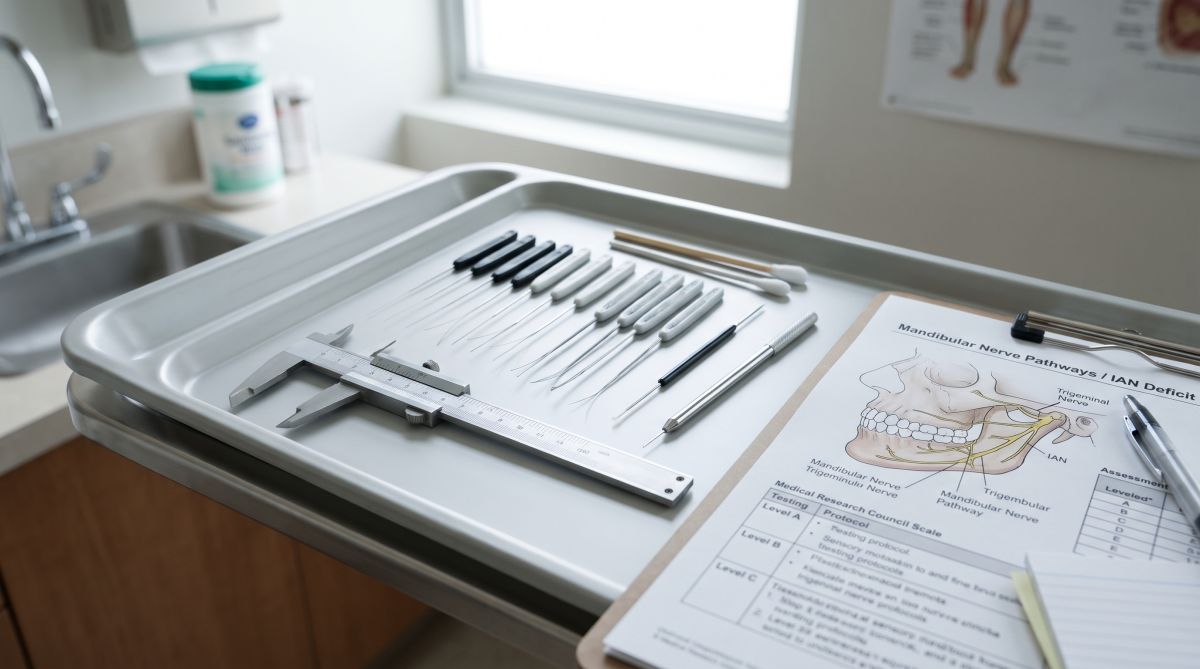
In contemporary maxillofacial surgery, clinical documentation must withstand unrelenting scrutiny. Yet across outpatient surgical practices, neurosensory assessment following iatrogenic nerve trauma remains surprisingly subjective.
All too often, office charts contain entries such as:
- "Patient states chin feels slightly less numb today."
- "Tested lip with cotton applicator; patient felt it."
- "Pinprick positive on left mental distribution."
These unstructured evaluations are clinically inadequate and legally vulnerable. Subjective assessments fail to distinguish between deep pressure perception and superficial touch, blur the line between normal recovery and neuropathic hyperesthesia, and obscure progressive sensory decline.
To deliver rigorous patient care, the dental and surgical professions must adopt standardized, reproducible clinical neurosensory testing (NST) matched to the Medical Research Council Scale (MRCS).
Originally developed in Great Britain for upper extremity peripheral nerve injuries and introduced to the trigeminal system by Dodson and Kaban, the MRCS provides an objective common language for diagnosing nerve trauma and evaluating surgical recovery.
The Three-Tiered Neurosensory Testing (NST) Protocol
A comprehensive clinical neurosensory examination evaluates distinct classes of sensory nerve fibers, organized from the largest, most myelinated axons down to unmyelinated nociceptive fibers.
Examinations should always proceed systematically from Level A to Level C:
+-------------------------------------------------------------------------+
| NEUROSENSORY TESTING BATTERY (LEVELS A-C)
|
| [ LEVEL A: Large Myelinated (A-alpha / A-beta) Fibers ] |
| * Static Two-Point Discrimination (Normal: 2-6 mm; Abnormal: >15 mm)
| * Directional Brush-Stroke Identification (Von Frey / Camel hair)
| * Stimulus Localization (Patient points to touched site with eyes
| closed; normal within 3-5 mm)
|
| [ LEVEL B: Medium Myelinated (A-beta) Fibers ]
| * Light Touch Perception (Semmes-Weinstein Monofilaments / Cotton)
|
| [ LEVEL C: Small Myelinated & Unmyelinated (A-delta / C) Fibers ]
| * Pain & Thermal Perception (Sharp pinprick / 27-gauge dental needle)
+-------------------------------------------------------------------------+
- Level A Testing (Tactile Discrimination): Static two-point discrimination is the most sensitive metric of functional innervation. Using a calibrated caliper or Boley gauge, apply light, uniform pressure without blanching the skin. Normal mental nerve innervation detects two points separated by 2 to 6 mm. A gap exceeding 15 mm indicates severe loss of discriminative tactile capability.
- Level B Testing (Light Touch): Evaluates general contact detection. Using calibrated Semmes-Weinstein monofilaments or fine cotton wisps, determine the absolute threshold of perception across the lower lip and chin relative to the contralateral, unaffected side.
- Level C Testing (Nociception): Assesses protective pain pathways using a sharp pinprick or dental explorer. Record whether the patient experiences dull pressure, sharp pain, complete absence of feeling, or painful hyperpathia.
The Modified Medical Research Council Scale (MRCS)
Once the testing battery is complete, the clinician synthesizes the objective findings into a standardized score. In our series of 186 inferior alveolar nerve repairs, this grading scale provided the exact framework used to quantify surgical success.
|
Grade |
Clinical Interpretation |
Detailed Diagnostic Criteria |
|
S0 |
No Sensation |
Complete absence of any neurosensory perception in the autonomous zone. |
|
S1 |
Deep Pain Only |
Preservation of deep cutaneous pain; absent superficial pain and touch. |
|
S2 |
Partial Sensation |
Some superficial pain and touch sensation present. |
|
S2+ |
Hyperesthesia |
Superficial pain and touch present, but accompanied by uncomfortable, painful oversensitivity (dysesthesia). |
|
S3 |
Useful Sensory Function |
Superficial pain and touch restored without hyperesthesia; static two-point discrimination >. |
|
S3+ |
Useful Sensory Function |
Intact pain and touch; good stimulus localization; static two-point discrimination between 7 and 15 mm. |
|
S4 |
Complete Sensory Recovery |
Normal sensation; sharp stimulus localization; static two-point discrimination restored to 2 to 6 mm. |
Note: Grades S3, S3+, and S4 constitute Functional Sensory Recovery (FSR)—the clinical benchmark for successful nerve restoration.
Translating MRCS Scores into Surgical Decision-Making
Deploying this classification changes your clinical triage from subjective guesswork into an objective roadmap:
+-------------------------------------------------------------------------+
| MRCS CLINICAL TRIAGE WORKFLOW |
| |
| [ Grade S0 to S1 at 8 Weeks ] -> Severe Axonotmesis or Neurotmesis. |
| Immediate microsurgical referral |
| indicated. |
| |
| [ Grade S2+ with Neuroma ] -> Unfavorable Regeneration. |
| Painful dysesthesia warrants |
| microsurgical decompression or |
| neuroma excision. |
| |
| [ Progressive S2 to S3+ ] -> Favorable Regeneration. |
| Serial monitoring justified; |
| conservative care continuing. |
+-------------------------------------------------------------------------+
A patient who presents with an MRCS grade of S0 to S2 at two to three months post-operatively is an immediate candidate for microsurgical consultation. In our clinical series, all 186 operated nerves presented with pre-operative baseline scores of S2 or lower. Following microsurgical intervention, 81.7% advanced into the functional tiers of S3, S3+, and S4, with 44.1% achieving total complete recovery (S4).
"Prosthetics drive implant surgery, and objective metrics must drive surgical decision-making. You cannot manage what you do not measure."
Establishing Institutional Consistency
Adopting standardized neurosensory testing and the MRCS in your practice requires minimal equipment: a pair of calipers, fine monofilaments, and a diagnostic pinprick. The investment takes less than five minutes of chairside time per examination.
By integrating this objective framework into routine post-operative care, we elevate clinical documentation, protect our practices from medico-legal ambiguity, and ensure that patients with non-recovering nerve injuries receive timely, sight-restoring microneurosurgical care.